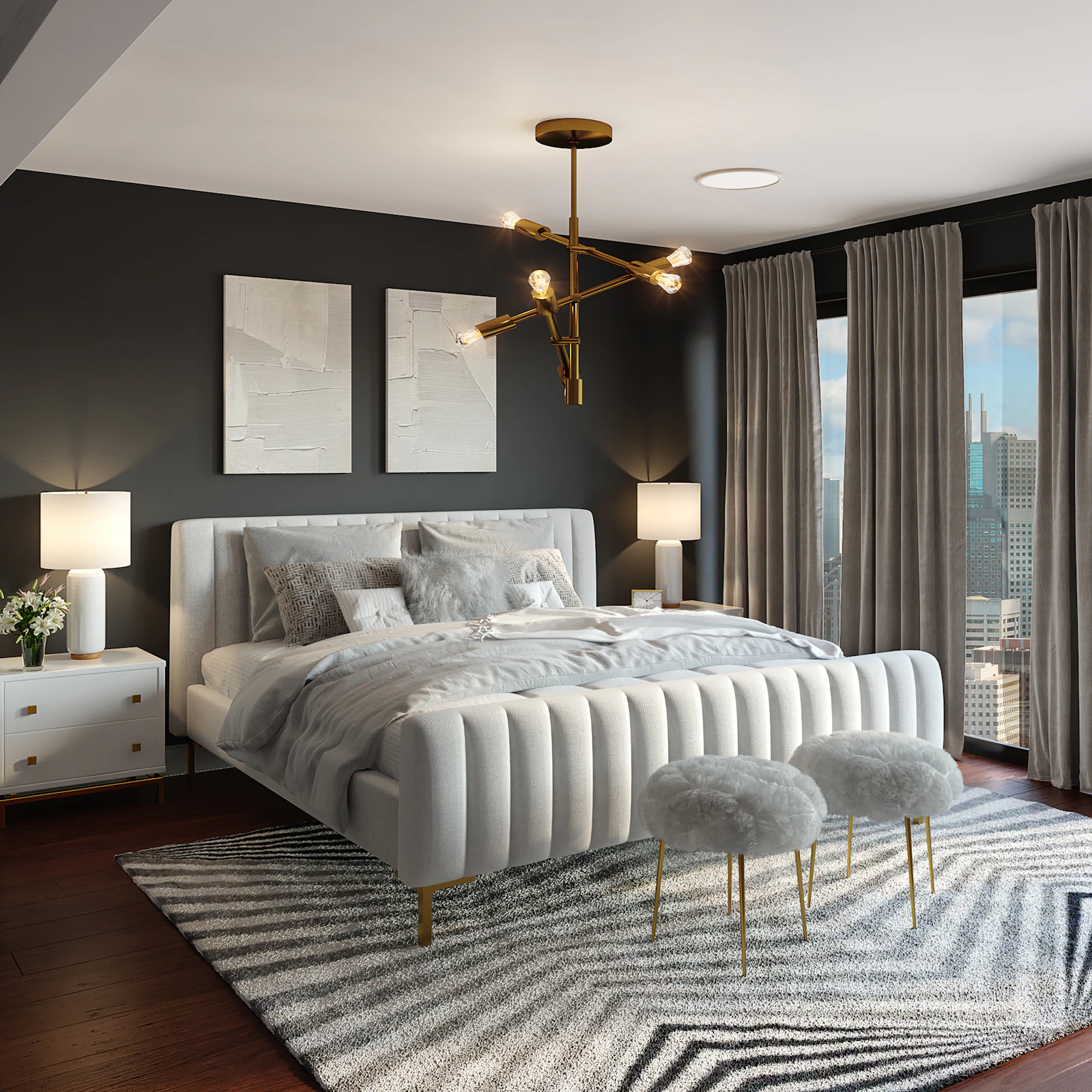
A bedroom is not a stage for a theater
Many bedrooms are designed to be photographed: ornate headboards, elaborate chandeliers, layers of throw pillows. But at ten at night, when you actually lie down, these 'focal points' become distractions.
A Japandi bedroom does the opposite: it isn't designed to be looked at, but to make you forget it exists.

Four dimensions: calm, lying down, night, bedroom, Japandi, cotton and wood
The underlying logic of this space is: calm (feeling) + lying down (ritual) + after ten at night (time) + bedroom (space) + Japandi (aesthetic) + cotton, wood, dim light (senses).
A low bed frame brings the sight line closer to the ground, and the body instinctively feels stable; without redundant decoration, the eyes aren't forced to 'process information' after getting into bed; natural materials absorb sound and light, making the room quiet.

Counter-intuitive conclusion: a bedroom that sleeps well may look a little 'empty'
We often equate 'cozy' with 'full': more throw pillows, more blankets, more wall art. But for sleep, too much visual stimulation keeps the brain alert.
A bedroom that truly helps sleep may look emptier than you imagine. This 'emptiness' isn't coldness; it's room for the nervous system to rest.

Key points for building a Japandi bedroom
Keep the bed low. You don't need a tatami bed, but the lower the overall height of mattress and frame, the more grounded the space feels.
Be restrained with color. White, cream, light gray, and light wood as the base, with at most one darker wood or terracotta tone as an anchor.
Reduce light sources. At night you only need one or two low-color-temperature point-source lights. Overhead lights are best turned off half an hour before bed.
Use natural materials. Cotton and linen bedding, solid wood nightstands, and woven storage baskets feel more relaxing than synthetic materials to both touch and sight.

The cost of decorating and furnishing
A Japandi bedroom looks simple, but 'simple' is often more expensive. Because every exposed thing has to withstand scrutiny, cheap products stand out especially in such a space.
Another cost is maintenance. Light bedding, natural wood, and cotton-linen fabrics need more careful care. They aren't as stain-resistant and durable as synthetic materials, but it's exactly this 'need to be cared for' quality that creates a relationship between the space and its user.
The biggest cost may be psychological: once you get used to emptiness and quiet, it's hard to go back to a bedroom filled with things. You'll start to be picky about every item that enters the bedroom.